The parish church of Sainte-Libaire in La Broque is the heir to a priory founded around 810 by Vicpodus (Vipode), the twelfth abbot of Senones. The Benedictine scholar Dom Calmet writes: "It is believed that [perhaps] the parish church of La Broque or Vipucelle was the priory church," and adds that ancient stone coffins and the foundations of considerable buildings were still to be found in the cemetery.
Attached to the bishopric of Metz by charter in 826, the parish later came under the jurisdiction of the Diocese of Toul, whose right of appointment and tithes were held by the Abbey of Senones. In 1871, following annexation by the German Reich, it was transferred to the Diocese of Strasbourg — an affiliation that has remained ever since.
Unique in the Diocese of Strasbourg, the church of La Broque is the only parish dedicated to Saint Libaire.
"I am the way, the truth and the life."John 14:6
The parish of Vipucelle (La Broque) depended on the priory of Senones. The abbey was subject in temporal matters to the Bishop of Metz and in spiritual matters to the Bishop of Toul, before gradually asserting its independence from 1243 onwards.
The abbots obtained the right to wear mitre and crozier. Like Étival, Moyenmoutier and Saint-Dié, the abbey claimed to belong to "no diocese" and appealed, when necessary, directly to the pope or to the bishops of Trier or Besançon.
The Abbot of Senones was the ordinary prelate, patron and tithe-collector of the parish; the parish priest received one third of the tithes. The parish had Framont as an annex and Albet, Les Cuvelles, Fuancon-Rup, Grand-Fontaine, Vacquenoux and the farms of Salm Castle as dependencies.
Creation of the Diocese of Saint-Dié. The Abbey of Senones, which had long claimed to belong to "no diocese," reluctantly came under this new jurisdiction.
The parish of La Broque thus passed under the authority of the Bishop of Saint-Dié, ending centuries of abbatial independence.
The Principality of Salm is annexed by France and incorporated into the Vosges département. The Abbey of Senones, suppressed in the 1790s by revolutionary decrees, permanently ceases to exercise any authority. The parish remains under the jurisdiction of the Bishop of Saint-Dié.
Following annexation by the Reich, the cantons of Saales and Schirmeck are incorporated into the Reichsland of Alsace-Lorraine and attached to the Diocese of Strasbourg.
Alsace returns to France, but the cantons of Saales and Schirmeck remain part of Alsace and the Diocese of Strasbourg — as they still are today.
Vicpodus (Vipode), the twelfth abbot of Senones, founds at Vipucelle the priory known as "Saint-Sauveur de la Cour d'En-Haut." Dom Calmet identifies it as the origin of the parish church.
By charter, Vipode donates the priory and its dependencies to the bishopric of Metz.
Two clerics from Strasbourg seize the church of Vipucelle during the episcopate of Herman. The Bishop of Toul lodges a complaint. The Bishop of Strasbourg excommunicates the clerics. Pope Leo IX confirms the restitution of the parish to the Diocese of Toul by bull addressed to Udon.
Confirmation of the church of Vipucelle (right of appointment and tithes) to the monastery of Senones.
Pope Eugene III confirms to the monastery its possession of Vipucelle with the church and the weekly Saturday market.
Dom Arnoux (Arnoù) de Salm, titular prior of the Cour d'En-Haut in the Val de la Broque, is mentioned in the abbey's records. Permission granted on 27 March 1492.
A funerary slab bearing the symbols IHS-MARIA and MEMENTO MORI, set into the church wall facing the pulpit. A testament to the antiquity of the burial site.
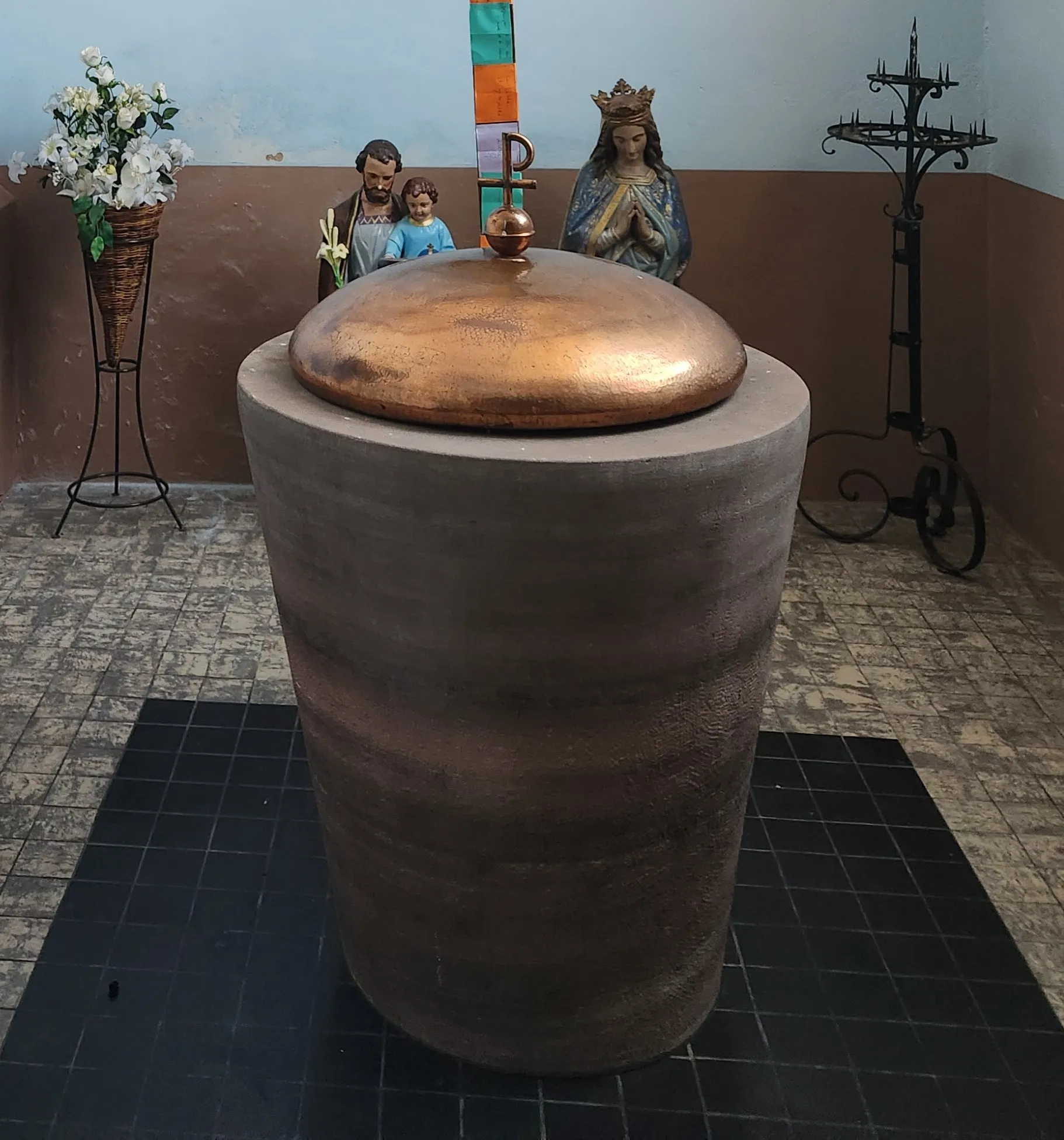
Foundation deed of the Rosary Confraternity, mentioning the church and a chapel it then possessed (most likely where the baptismal chapel stands today).
Funerary slab of Jean Henry François, son of Henri Hersent, aged 2, who died on 11 January 1719 at La Broque "en Lorrainne."
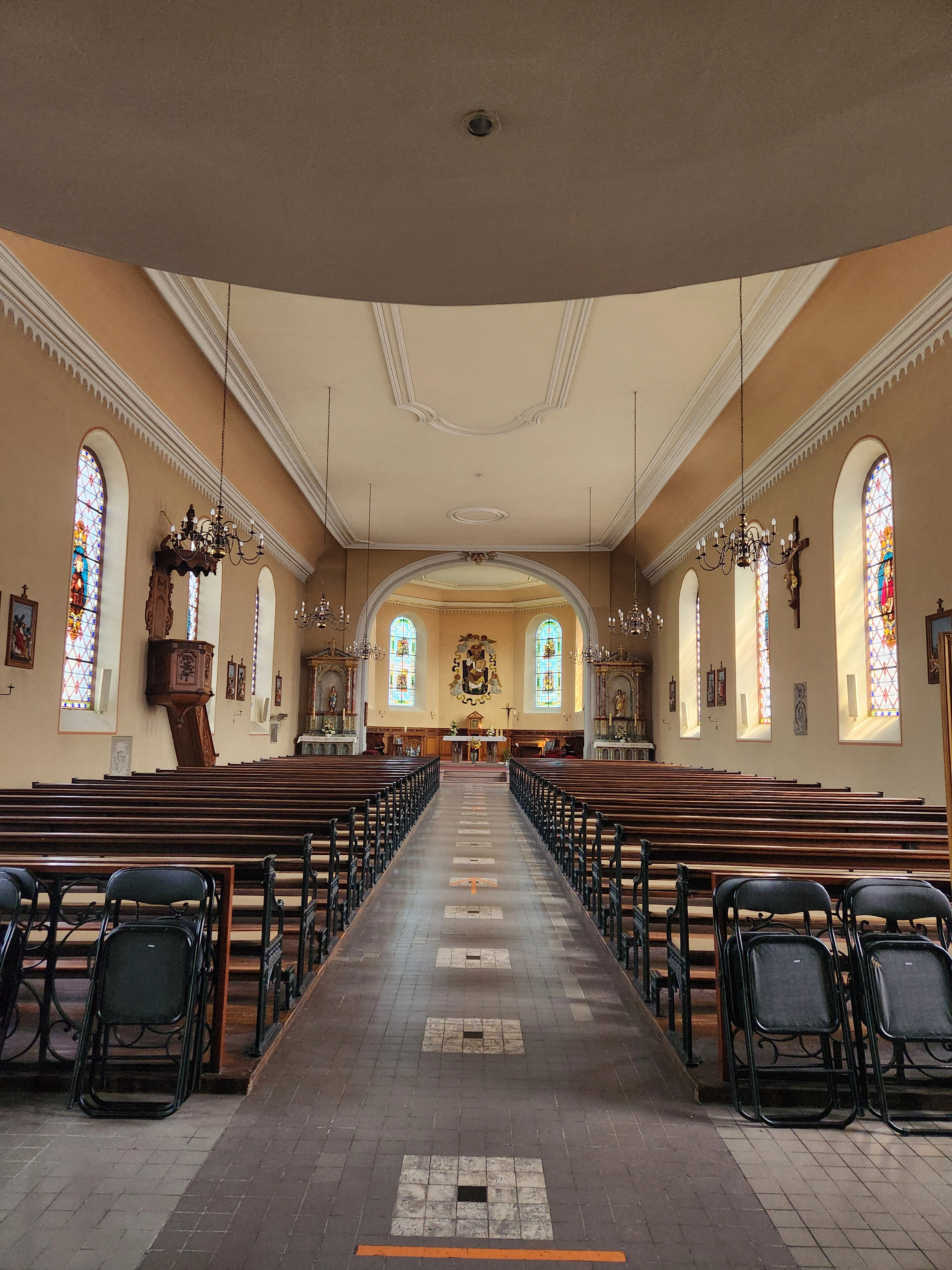
The nave is entirely rebuilt for approximately 2,500 livres. Work begins in 1736 (Dom Calmet) and is completed in 1737, the date carved on the keystone of the portal. Only the tower-porch survives to this day.
Jean-Baptiste Fourno, founder to the King of Poland, casts the great bell. A gift from the Princes of Salm: godfather Prince Louis Charles Otton de Vipucel et Ban de Salm, godmother Princess Josèphe de Salm-Salm. 930 kg, pitch F. Listed on the supplementary inventory of classified movable objects in 1996.
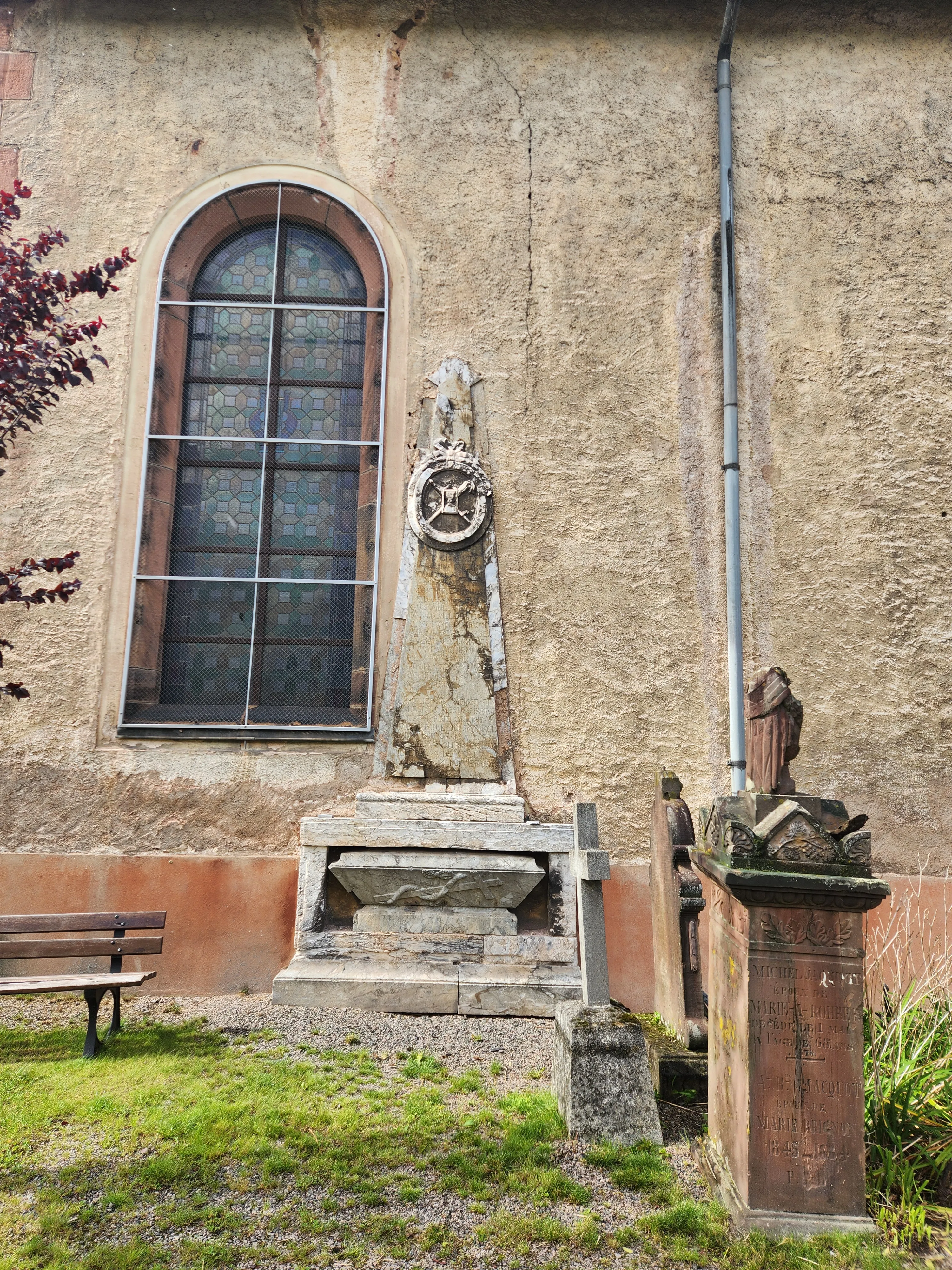
Funerary monument of Catherine Guetre Monfort (born 1711, died 1785 at Schirmeck) and Marguerite Parisot (born 1729, died 1785 at La Broque), later set into the wall during the 1869 works.
La Broque is annexed by France and incorporated into the Vosges département, passing under the spiritual jurisdiction of the Bishop of Saint-Dié.
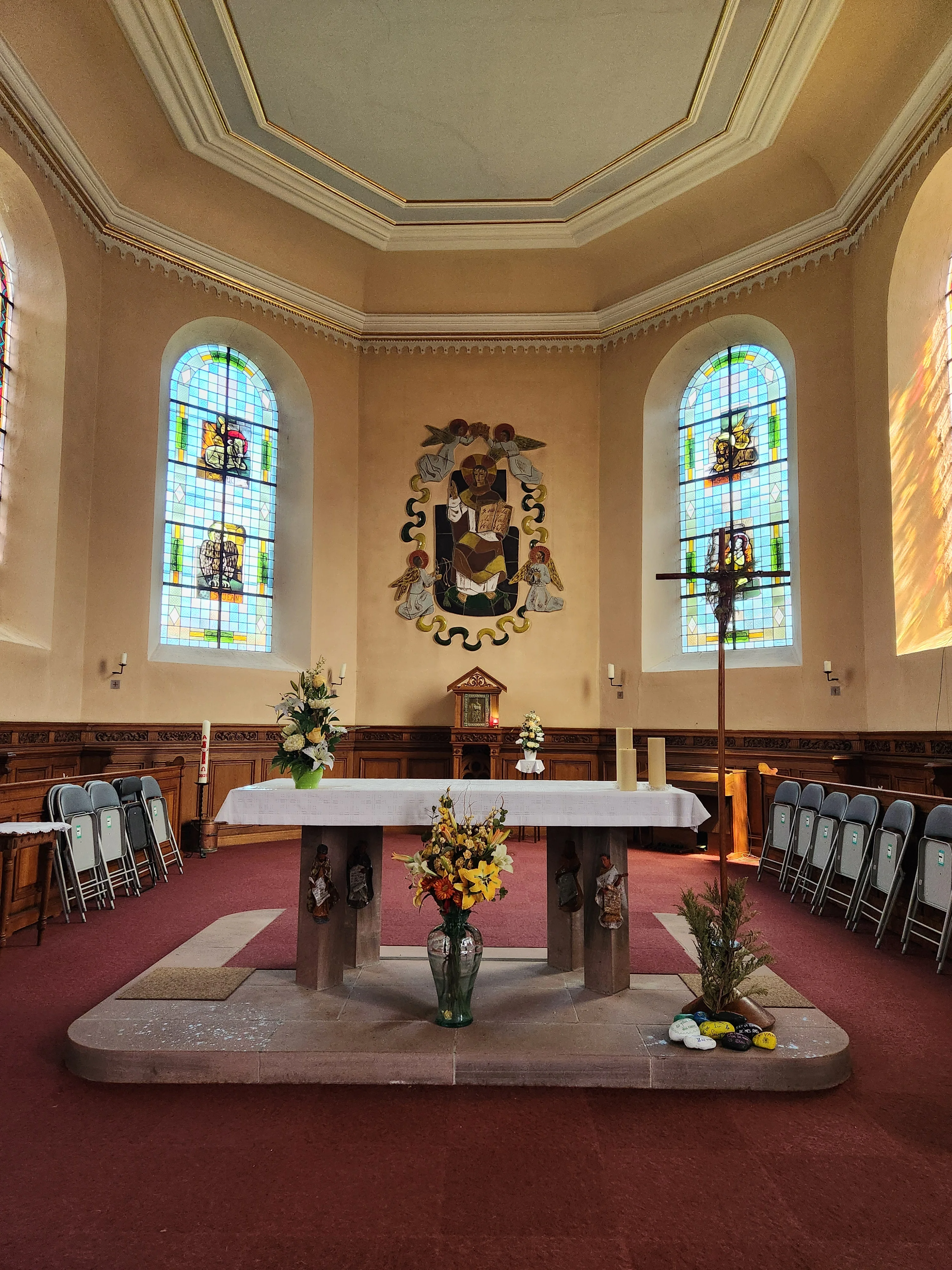
The chancel is enlarged. Parish priest Précheur notes: "In 1827 the church was enlarged by the chancel."
Installation of 20,000 shingles for roofing: labour and transport costing 166 francs.
The proceeds of a timber sale are allocated to "the erection of the bell tower, which the parish church lacked" (municipal archives). Yet engravings by Muller and Simon dated 1837 already show an existing bell tower, lower than today, with two windows per face (only the upper one survives) and adjoining the nave without being integrated into the building. The great bell of 1770, which had two companions, necessarily required a tower to house them, as was customary in all churches of the region. That same year, to avoid any risk of accident, the gallery and main door — "both dilapidated and threatening to collapse shortly" — are demolished and rebuilt for 569 fr. 35.
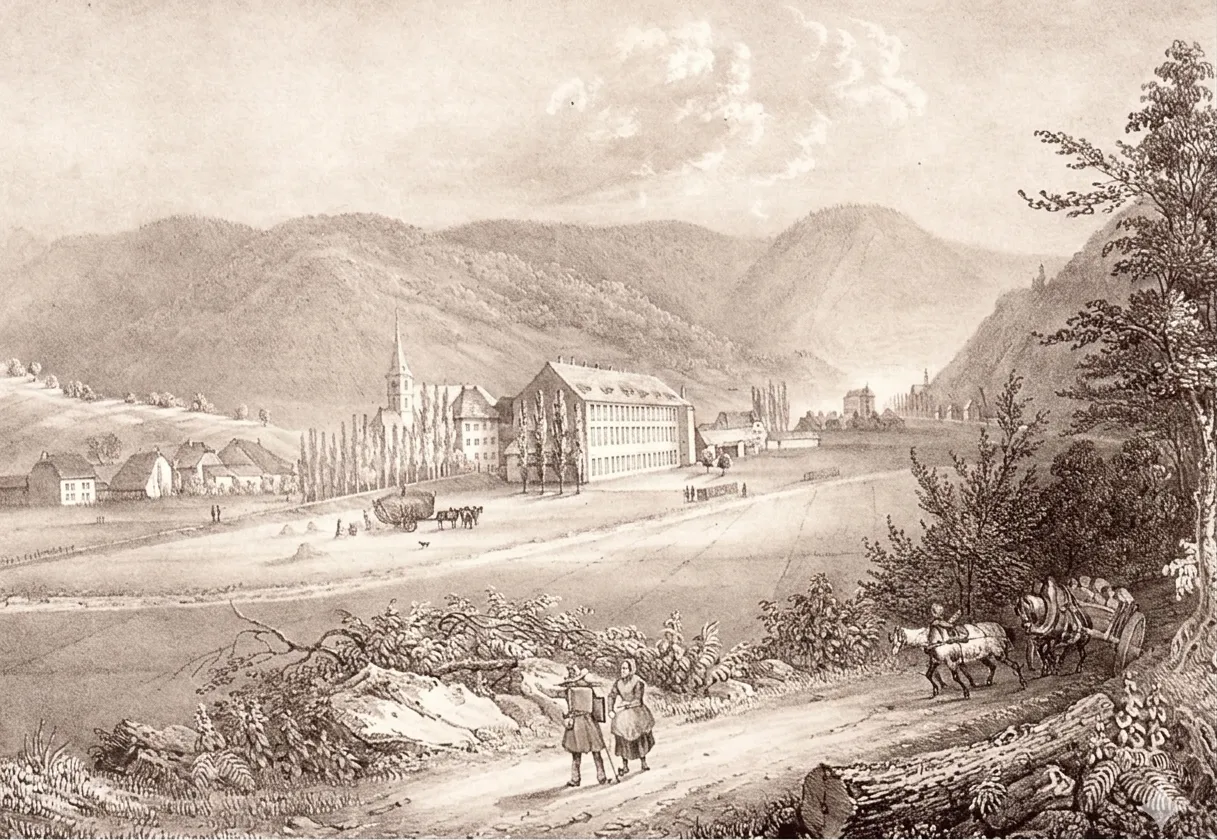
Engraving by Muller and Simon, 1837 — the bell tower is already visible.
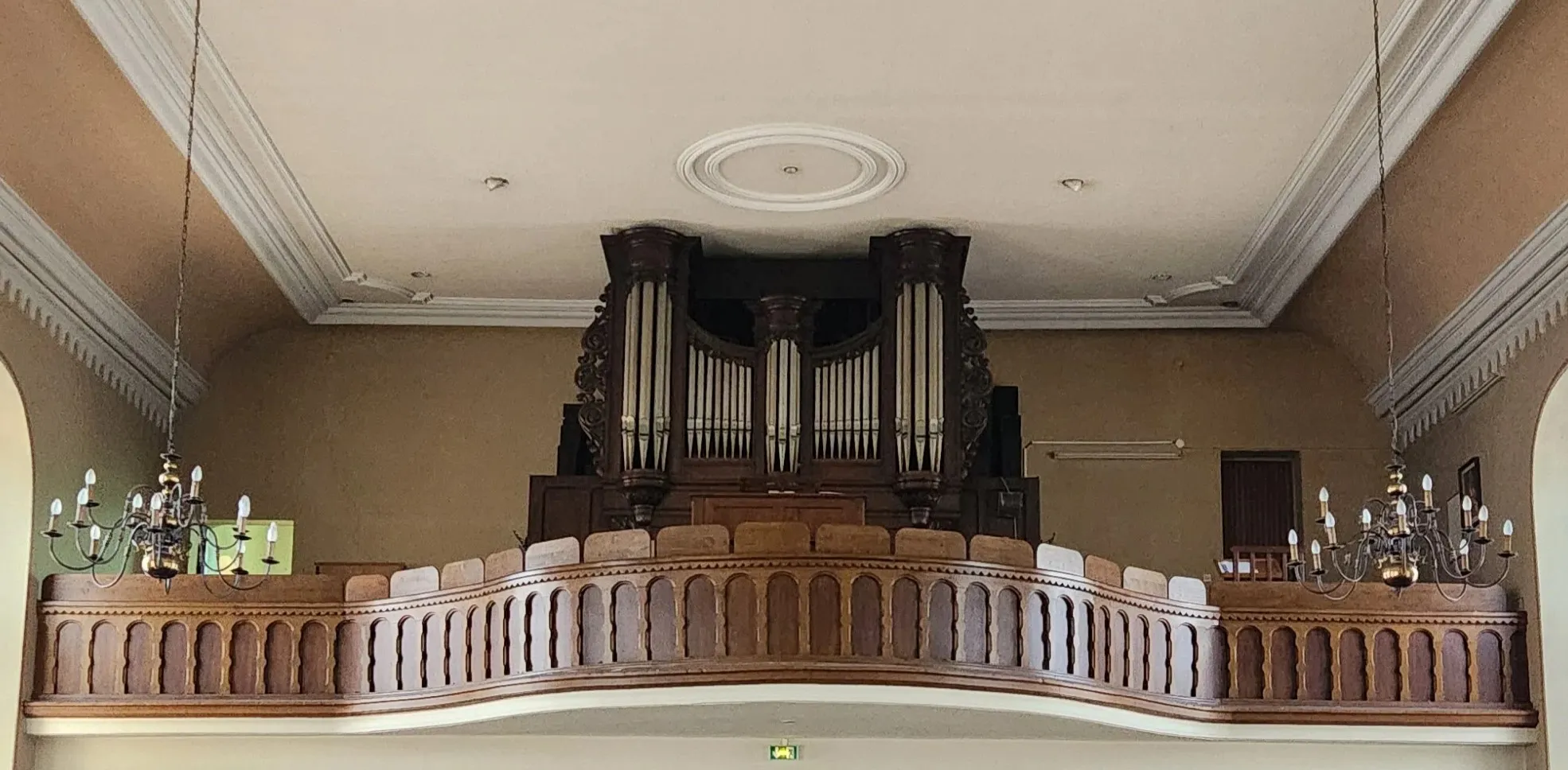
An organ is commissioned from Martin Wetzel, housed in an elegant oak case. Single manual, approximately 10 stops, 15-note pedalboard.
The church and the tower spire are to be re-roofed. Cost of works: 2,427 fr. 08 + 1,072 fr. 92 of timber taken from the communal forest.
Repair of windowpanes and installation of curtains on the nave windows, total cost 700 fr.
François Eugène Grijolot, district architect for the Vosges, draws up a restoration project and plans for La Claquette.
This is the most significant transformation of the building, carried out to Grijolot's plans. Works included:
Jean-François Précheur, parish priest since 1825, made no secret of his opposition to these works: "In 1869 repairs were carried out on the church that I did not approve of. The old church should have been razed and a new one built alongside, worthy of the parish. The works began on 20 June, which was cold. I returned to the church on 19 December of the same year."
Following the Treaty of Frankfurt, the cantons of Saales and Schirmeck are incorporated into the Reichsland of Alsace-Lorraine and attached to the Diocese of Strasbourg.
The organ's façade pipes are requisitioned for smelting (war metal). Two of the three bells are also requisitioned; the smallest is lost, the other recovered but recast. The great bell of 1770 is spared, probably because of its connection to the Princes of Salm.
Alsace returns to France. The cantons of Saales and Schirmeck remain attached to the Diocese of Strasbourg.
Two bells are blessed under parish priest Antoine Rapp: "Libaire" (G, 650 kg) and "Marie-France" (A, 460 kg).
Commission to Joseph Rinckenbach (Ammerschwihr), opus 197: 18 stops on 2 manuals and pedalboard. The 19th-century Wetzel case is retained.
Artillery fire during the Liberation damages the chancel windows (the Ascension and the Assumption, 1869), which will need to be replaced.
Restoration of the red Champenay sandstone ashlar of the portal.
The organ is overhauled by Alfred Kern (Strasbourg-Cronenbourg). The firm A. Didelot (Sarrebourg) electrifies the bells and installs an automatic curfew chime at 10 p.m.
A major building campaign directed under parish priest Lucien Friederich, with artistic direction by Madame Adeline Hébert-Stevens (Mme Paul Bony, Paris).
Bishop Jean-Julien Weber of Strasbourg consecrates the church on the feast of Christ the King. Inauguration of the chancel windows by Adeline Hébert-Stevens (25 Oct.).
The ten grisaille windows of 1869 are entirely restored, along with the new inner door.
Architect Daniel Zinglé (La Broque) directs the restoration of the bell tower. A new cross and gilded cockerel are installed. High Mass with the Sainte-Cécile Choir, the Cercle Aloysia, the hunting horn players and local societies.
Prefectoral decree of 20 December 1996 listing the great bell cast by Jean-Baptiste Fourno in 1770 on the supplementary inventory of classified movable objects.
Inauguration of the interior restoration (paintings and alterations) under parish priest Jean Chamley.
As the Rinckenbach instrument had become unplayable, a liturgical electronic organ with 2 manuals and pedalboards is acquired. Blessed by Father Claude. The choirs of La Broque and La Claquette take part in the ceremony.
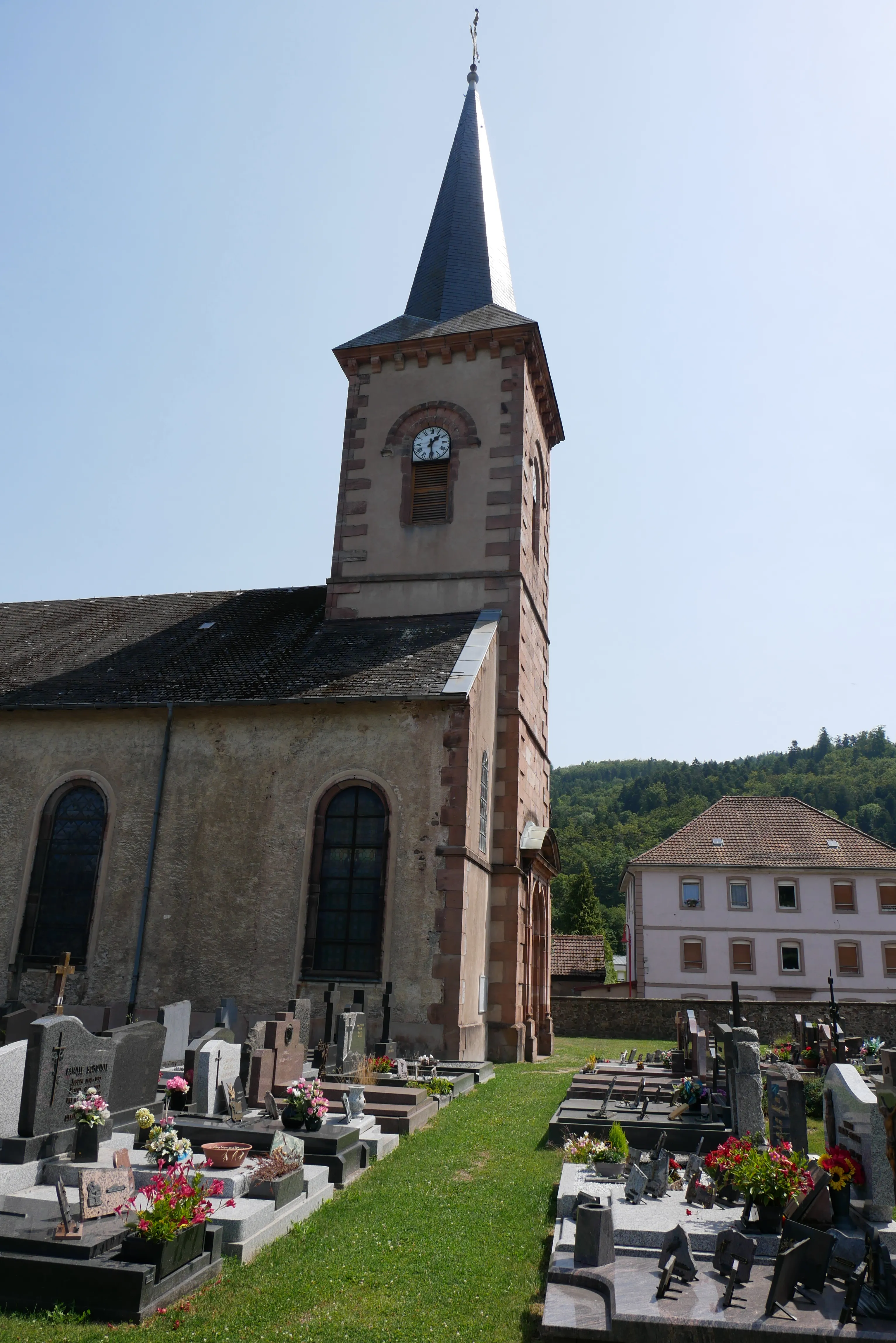
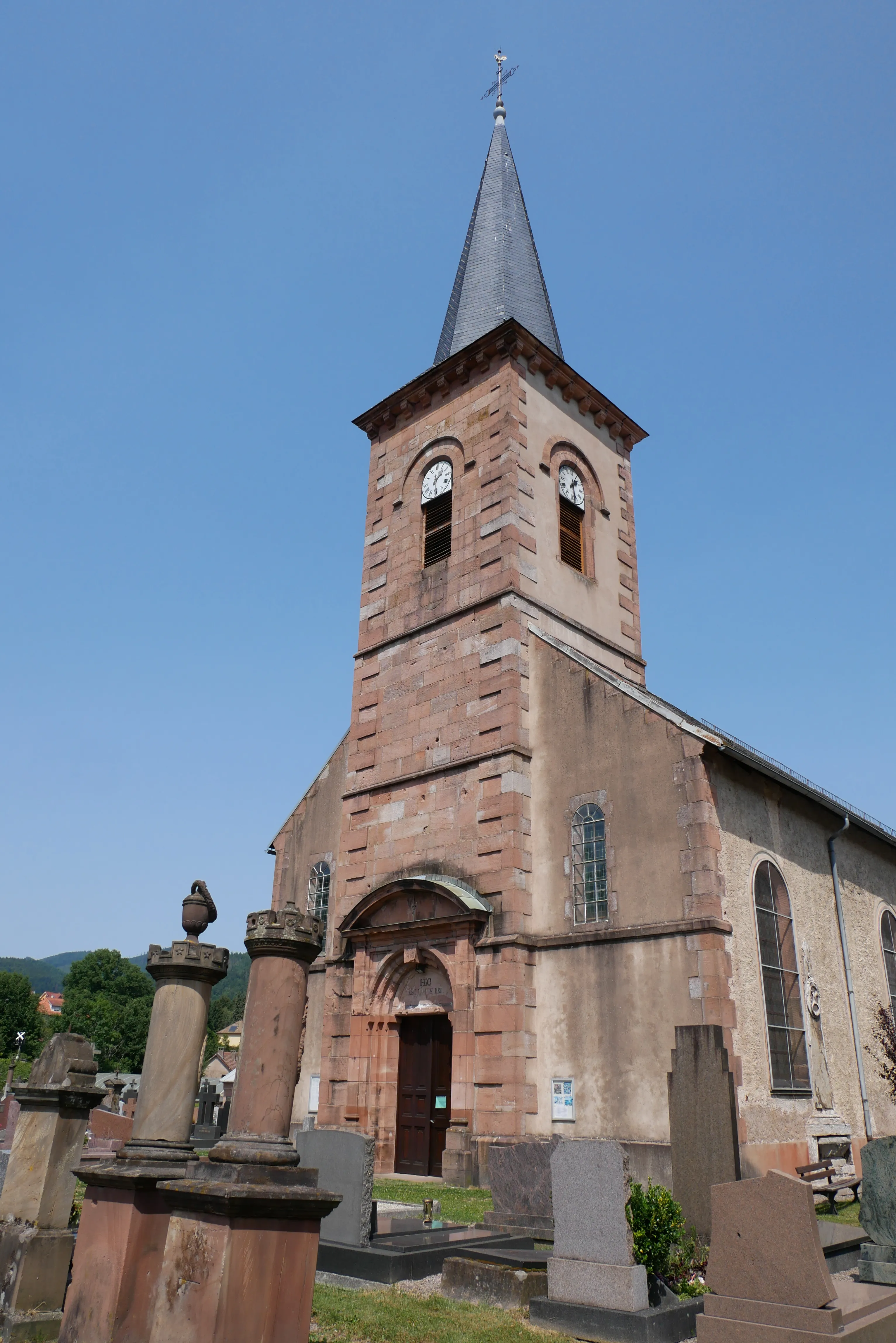
The church is built in rendered sandstone rubble, except for the front elevation of the tower-porch, which is constructed in dressed sandstone ashlar. It comprises:
The years 1737 and 1869 are carved on the pediment, recalling the two great building phases.

The pediment of the church with the dates 1737 and 1869.
From the booklet by architect Daniel Zinglé (1984 restoration):
The bell openings are closed by oak shutters stiffened by a frame that absorbs lateral forces. The tower's clock faces are visible on the sides of the bell tower.
A clearly visible vertical crack on the north wall of the nave bears witness to the addition of the chapel and the access to the tower during the 1869 works, which permanently integrated the bell tower into the structure. Similarly, the smaller corner stones towards the top of the tower attest to its raising on that occasion.
"The stone the builders rejected has become the cornerstone."Psalm 118:22 · quoted by Jesus in Matthew 21:42