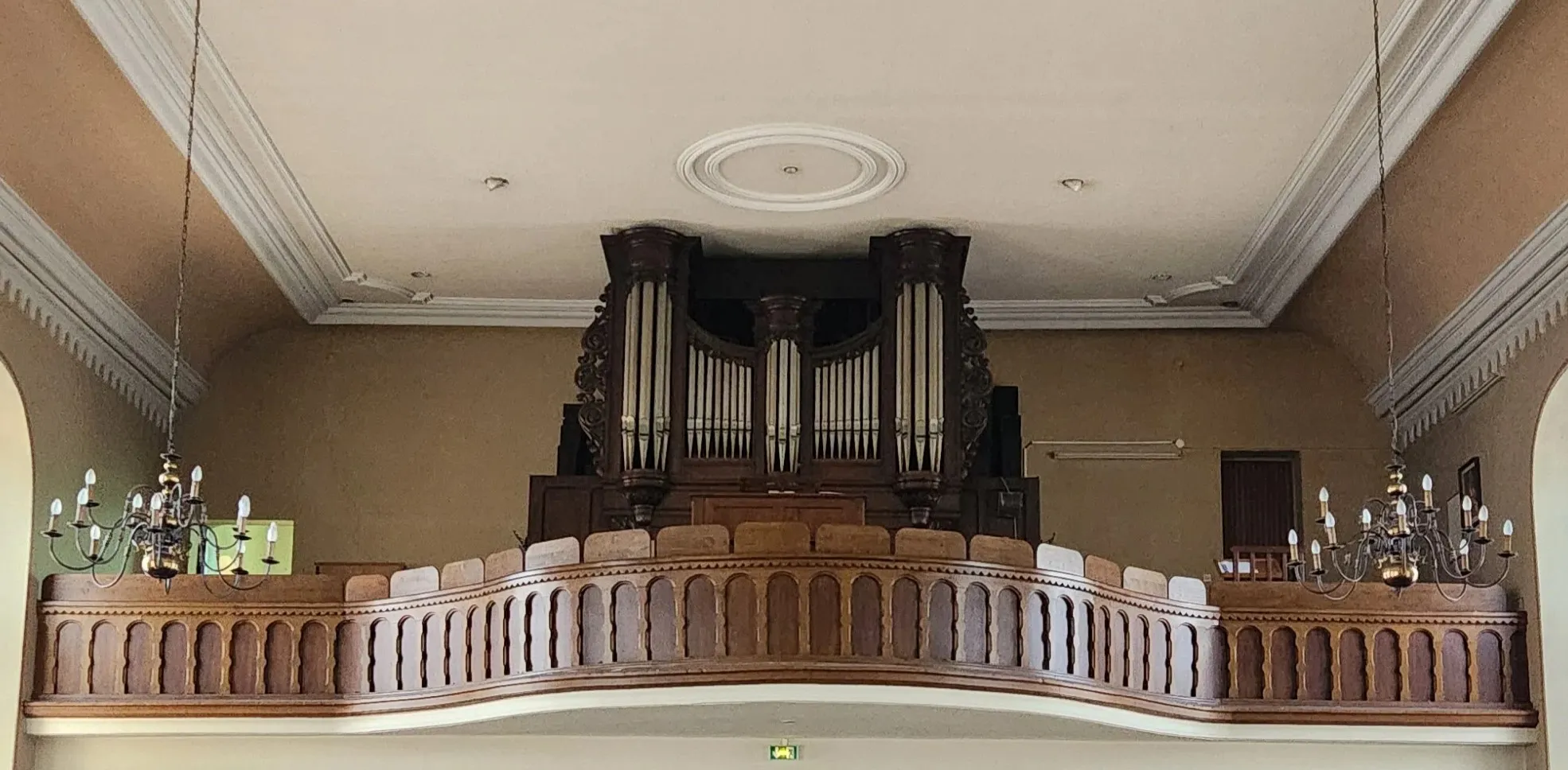
The organ of the Church of Sainte-Libaire has one of the finest histories in the Bruche Valley: its 1843 oak case, elegantly carved with acanthus leaves in the 18th-century taste, has survived wars, rebuildings and successive overhauls. It still stands in the organ loft today.
Two organs have occupied this case over the past 180 years: that of Martin Wetzel (1843) and that of Joseph Rinckenbach (1930, opus 197). Since 2010, an electronic instrument has provided liturgical accompaniment.
The oak case dates from 1843, made by Martin Wetzel. Measuring 2.90 m wide, it takes inspiration from the small Callinet organs. Its ornamentation includes floral garlands, carved cheeks and acanthus corbels — a legacy of 18th-century aesthetics.
When the Rinckenbach organ was commissioned in 1929–1930, it was decided to retain the original case and to add a rear enclosure for the pedal stops. The window console, however, was removed.
The Wetzel organ bench has been preserved. Its width of 113 cm provides a valuable clue as to the dimensions of the original instrument.
Both organ builders, Martin Wetzel and Joseph Rinckenbach, are cited in the Palissy file recording the church's furnishings.
"Praise him with harp and lyre, praise him with tambourine and dancing, praise him with strings and flute!"Psalm 150:3–4
In 1843, the parish commissioned an organ from Martin Wetzel, an organ builder established in Moselle and Alsace. The instrument was part of a series of six small organs from the 1840s in the region: Haut-Clocher, Langatte, Réding, Bust, Berstett and La Broque.
During the major works of 1869, the old pews and floor were removed. The organ was dismantled. In 1870, Martin Wetzel's sons reassembled the instrument in the rebuilt church. An overhaul in 1874 confirmed the 10 stops on the soundboard.
In April 1917, the German military authorities requisitioned the façade pipes for war metal smelting. The organ was thus stripped of its principal visual expression. Two bells were also requisitioned at the same period.
After the First World War, the Wetzel organ was in a deteriorated state. In 1929–1930, the parish commissioned a new organ from Joseph Rinckenbach, organ builder in Ammerschwihr (Haut-Rhin). This was opus 197 of the Rinckenbach workshop.
The specifications called for reusing as many parts of the old instrument as possible, in a spirit of economy and respect for the heritage.
In 1953, under parish priest Lucien Friederich, the organ was overhauled by Alfred Kern, organ builder in Strasbourg-Cronenbourg. This work was part of the many improvements carried out by Fr Friederich for the church.
Despite this overhaul, difficult climatic conditions and wear eventually rendered the instrument unplayable in the 2000s. The estimated cost of restoration proved too high for the parish, which decided to acquire an electronic organ.
In agreement with the parish committee, the decision was made to acquire an electronic instrument with 2 manuals and pedalboards. It was blessed by Father Claude during the Sunday Mass before an official inauguration in June 2010. (Dernières Nouvelles d'Alsace, 27 May 2010)
First titular organist: Patrice Ropp. The choirs of La Broque and La Claquette performed choral pieces during the service.
Martin Wetzel's beautiful 1843 oak case remains in the organ loft and is a major decorative element of the church, even though the mechanical instrument it once housed has gone.
The organ loft offers a sweeping view over the single-aisle nave. Its carved wooden balcony, with its rounded arches, is one of the most elegant features of the interior.
The loft is reached by a staircase whose well is illuminated by one of the lyre-motif windows — a fitting musical symbol.
"Come, let us sing for joy to the Lord; let us shout aloud to the Rock of our salvation."Psalm 95:1
These photographs, preserved by the reference website À la découverte de l'Orgue – Orgues d'Alsace, document the Rinckenbach instrument (1930).
Interior view of the console — Rinckenbach organ (opus 197, 1930)
© Eric Eisenberg / decouverte.orgue.free.fr
The independent console — Rinckenbach organ (opus 197, 1930)
© Eric Eisenberg / decouverte.orgue.free.fr
The console photographs come from the website decouverte.orgue.free.fr (Eric Eisenberg), a reference for the documentation of historic organs in France and Alsace.
.webp)
.webp)