The interior of the Church of Sainte-Libaire contains furnishings of great diversity: major 18th-century pieces (pulpit, chancel screen) stand alongside the works of 1869 (side altars, confessionals) and the contemporary creations of 1961 (main altar, ceramic, baptismal font).
Several pieces are listed on the Palissy inventory, the national database of French movable heritage.
"One generation shall praise thy works to another, and shall declare thy mighty acts."Psalm 145:4
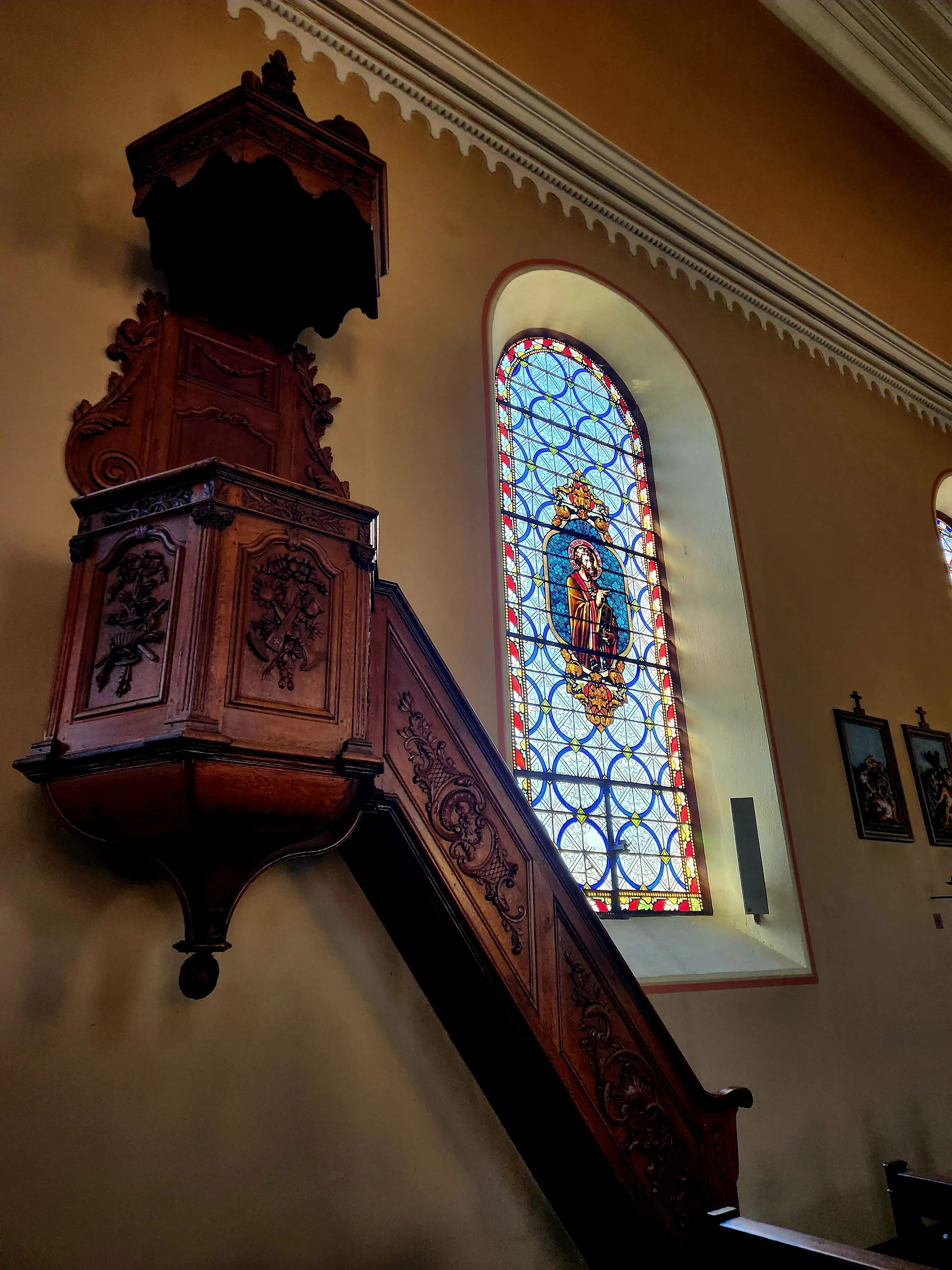
The pulpit is one of the most elegant and best-preserved pieces in the church. In oak, with a hexagonal plan, it comprises:
The tub panels are adorned with carved religious trophies: chalice, stole, candlestick, monstrance, Bible. The underside of the sounding board features a relief dove of the Holy Spirit.
Dated to the second half of the 18th century, the pulpit may have been altered during the works of 1869. It is placed along the north wall of the nave. A tombstone lies at its foot (1719).
The two side altars were installed during the major works of 1869. They are in neo-classical style.
Houses the polychrome statue of Saint Libaire (2nd half of the 19th c., carved polychrome wood, listed Palissy IM67015417). The saint is depicted in a red tunic, holding a shepherd's crook, an attribute recalling that she tended sheep at Grand (Vosges).
Houses a statue of the Virgin and Child. The Virgin stands, holding the infant Jesus.
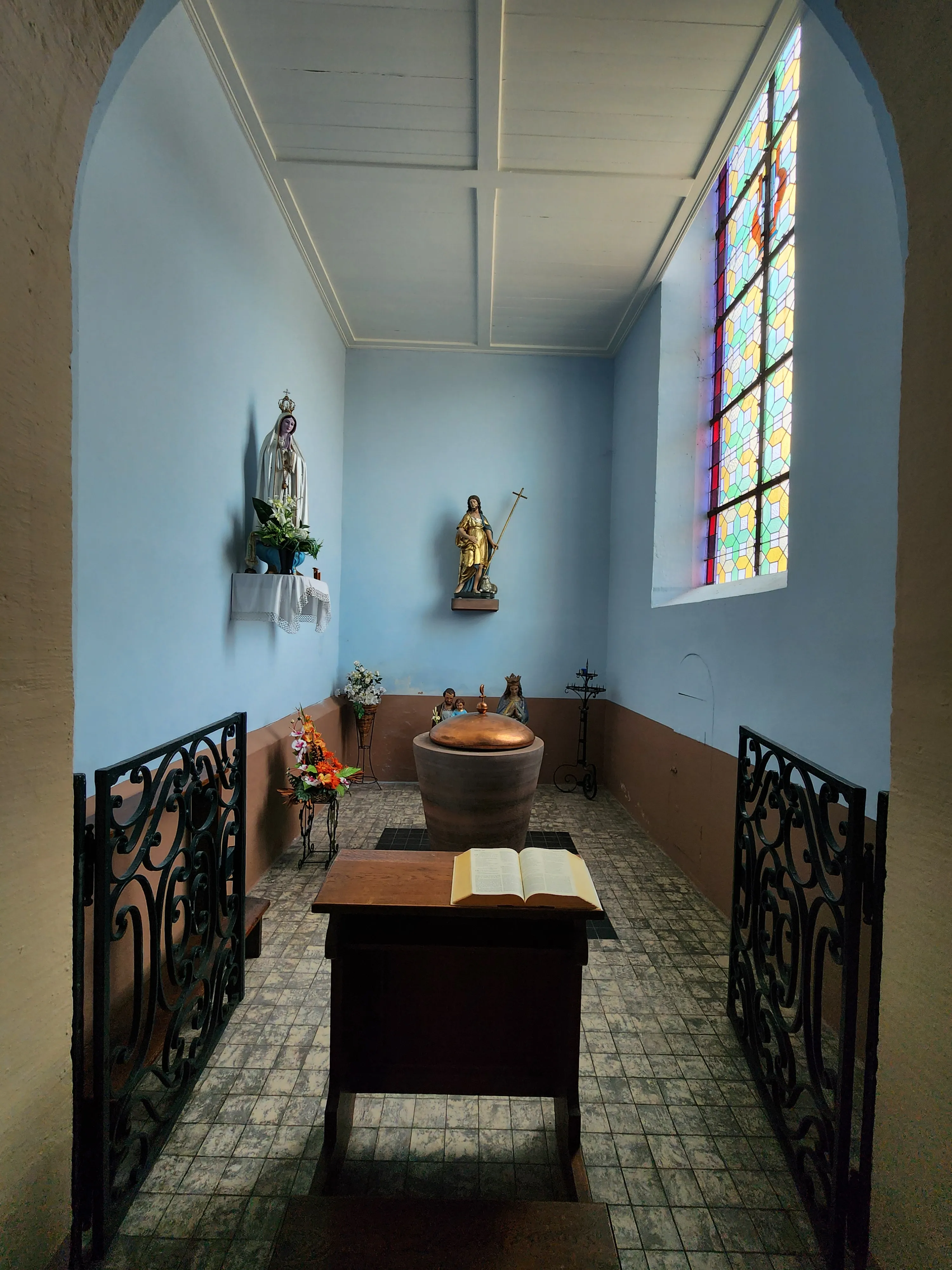
This wrought iron screen most likely dates from the reconstruction of 1737. It was dismantled, probably after the Second Vatican Council (1962–1965), which encouraged opening the chancel to the congregation.
Today, its elements are distributed in several locations:
These leaves are visible in the photographs of the baptismal chapel.
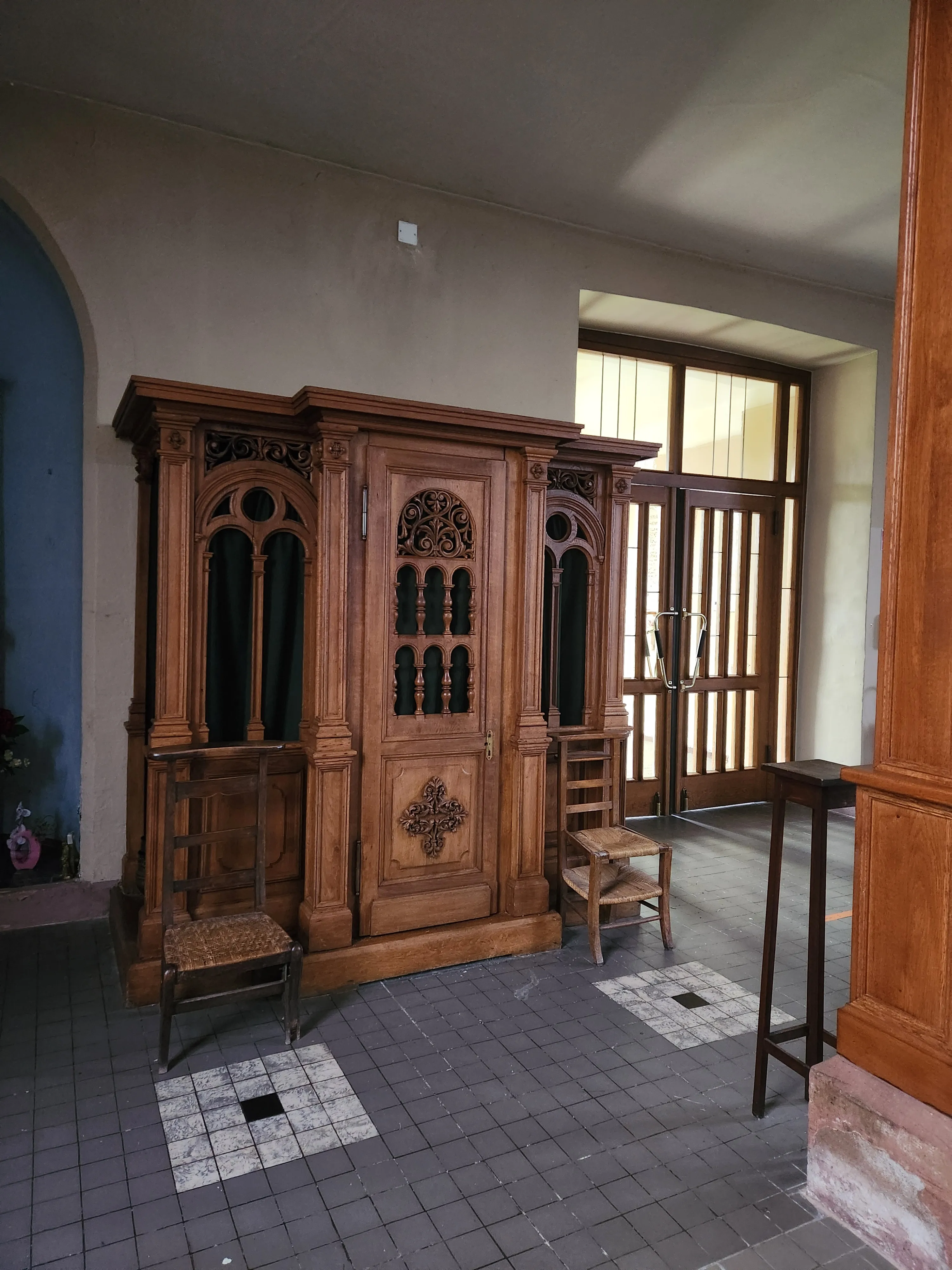
Installed during the works of 1869, the carved wooden confessional stands at the entrance to the church, between the icon of the Virgin of Perpetual Help and the door. Its three-compartment architecture (priest in the centre, penitents on each side) is typical of Alsatian neo-Gothic style.
"If we confess our sins, he is faithful and just to forgive us our sins, and to cleanse us from all unrighteousness."1 John 1:9
In addition to the major figures of Saint Libaire and the Virgin and Child on the side altars, the church houses other devotional representations throughout the nave and the baptismal chapel.
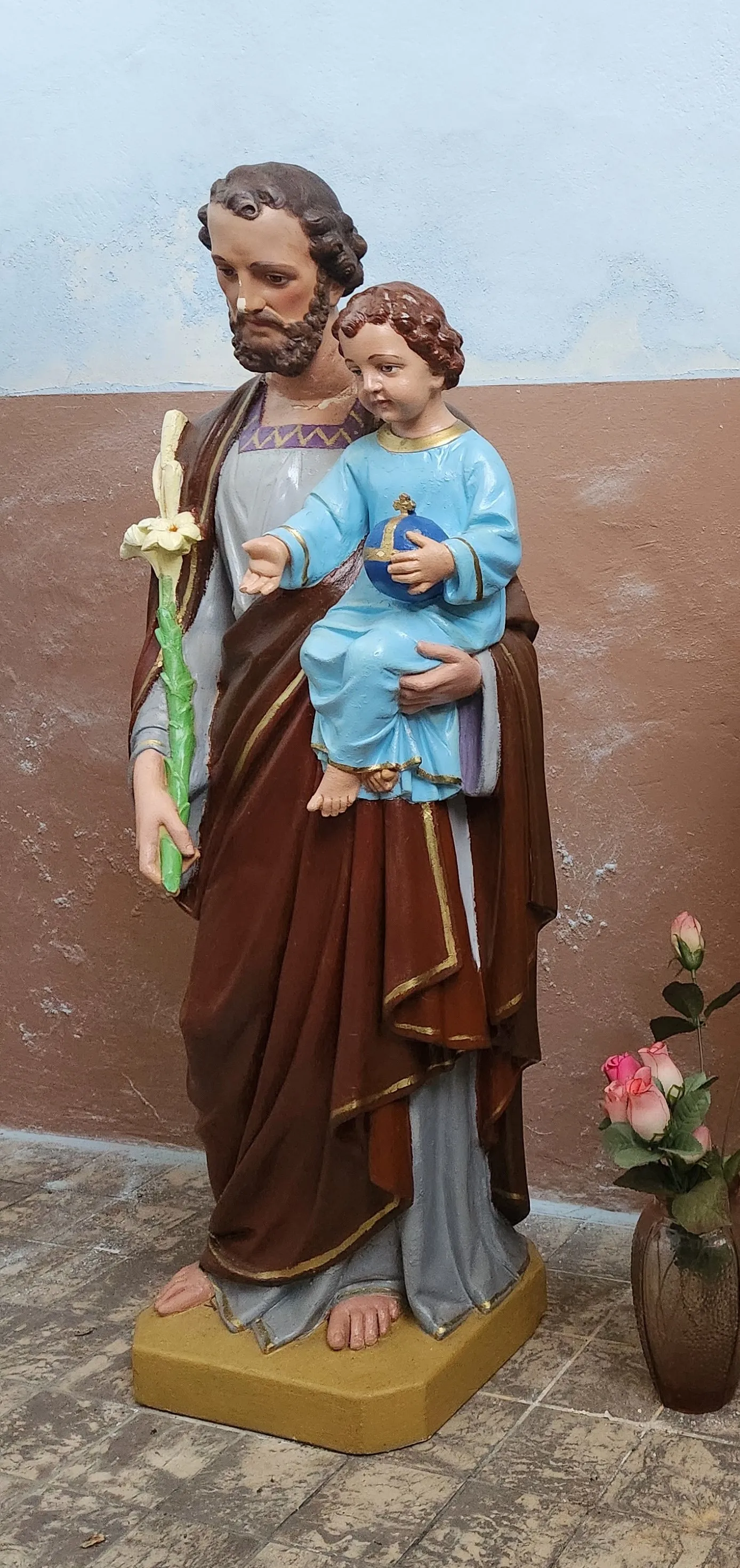
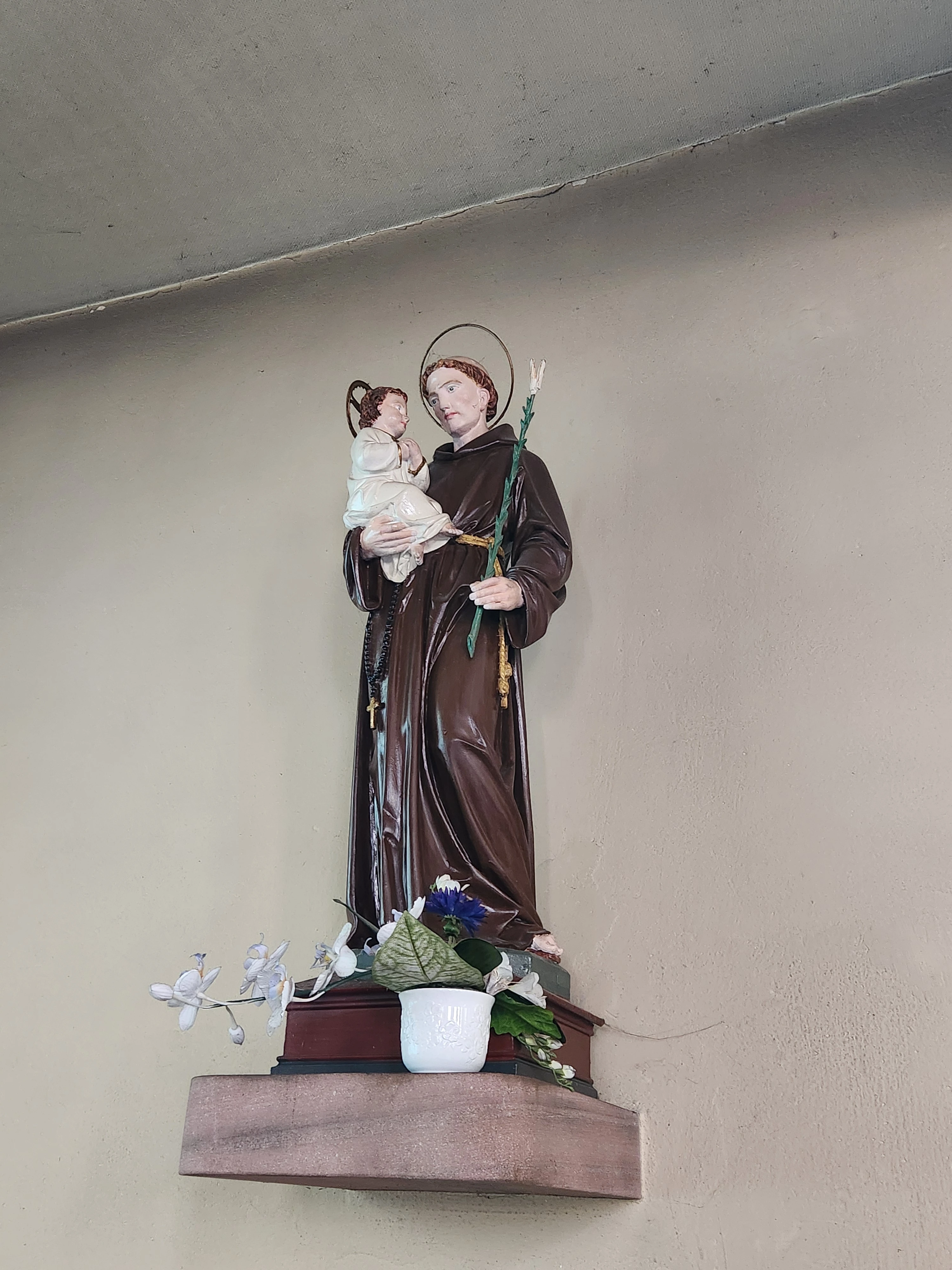
Depicted in brown Franciscan habit with the infant Jesus in his arms and a stem of white lily. Patron of lost objects and the poor, one of the most popular saints in the Catholic world.
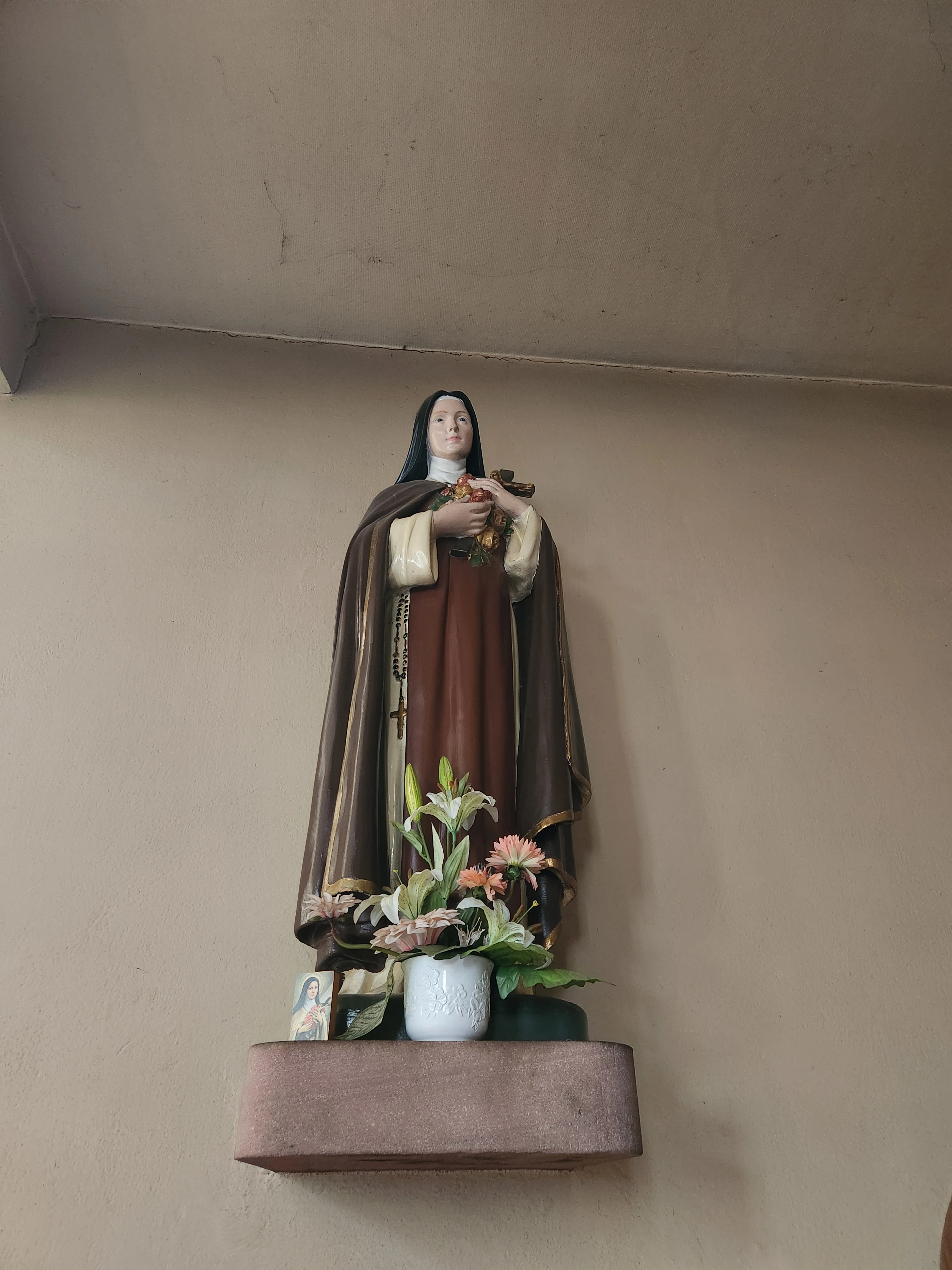
The "Little Flower," a Norman Carmelite (1873–1897), is depicted holding a bouquet of roses and a crucifix: her usual iconographic attributes. Doctor of the Church, greatly venerated in Alsace.
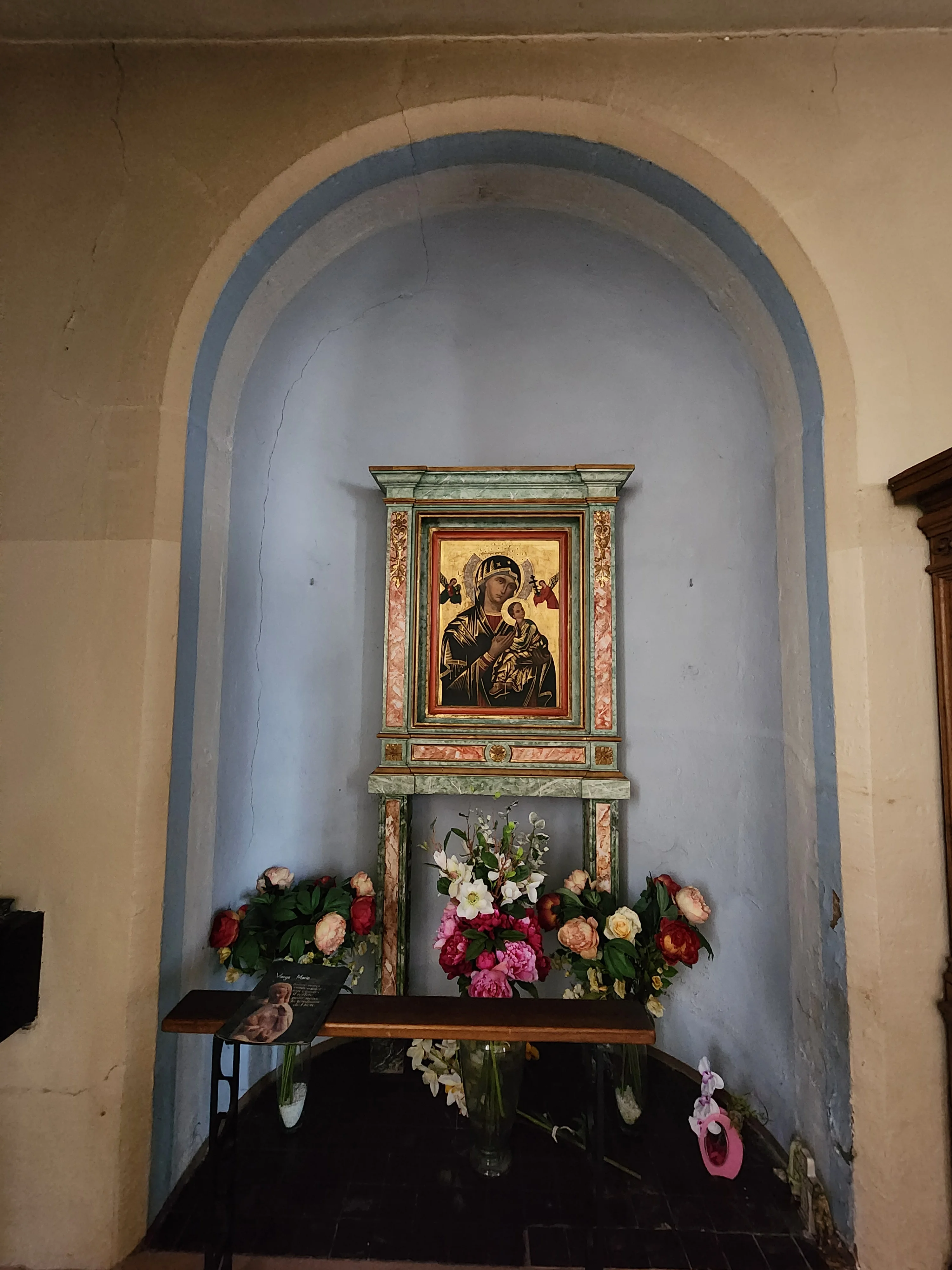
Set in a blue-painted alcove, this oratory displays an icon of the Virgin of Perpetual Help. In Byzantine style, it depicts Mary holding the infant Jesus, flanked by the archangels Michael and Gabriel.
Forerunner of Christ and central figure of baptism, this statue is fittingly placed in the baptismal chapel, recalling the sacramental function of the space.
Statue of the Virgin of Fátima (the 1917 apparition in Portugal) on the left wall of the chapel. She is depicted in her white mantle edged with gold and her crown.
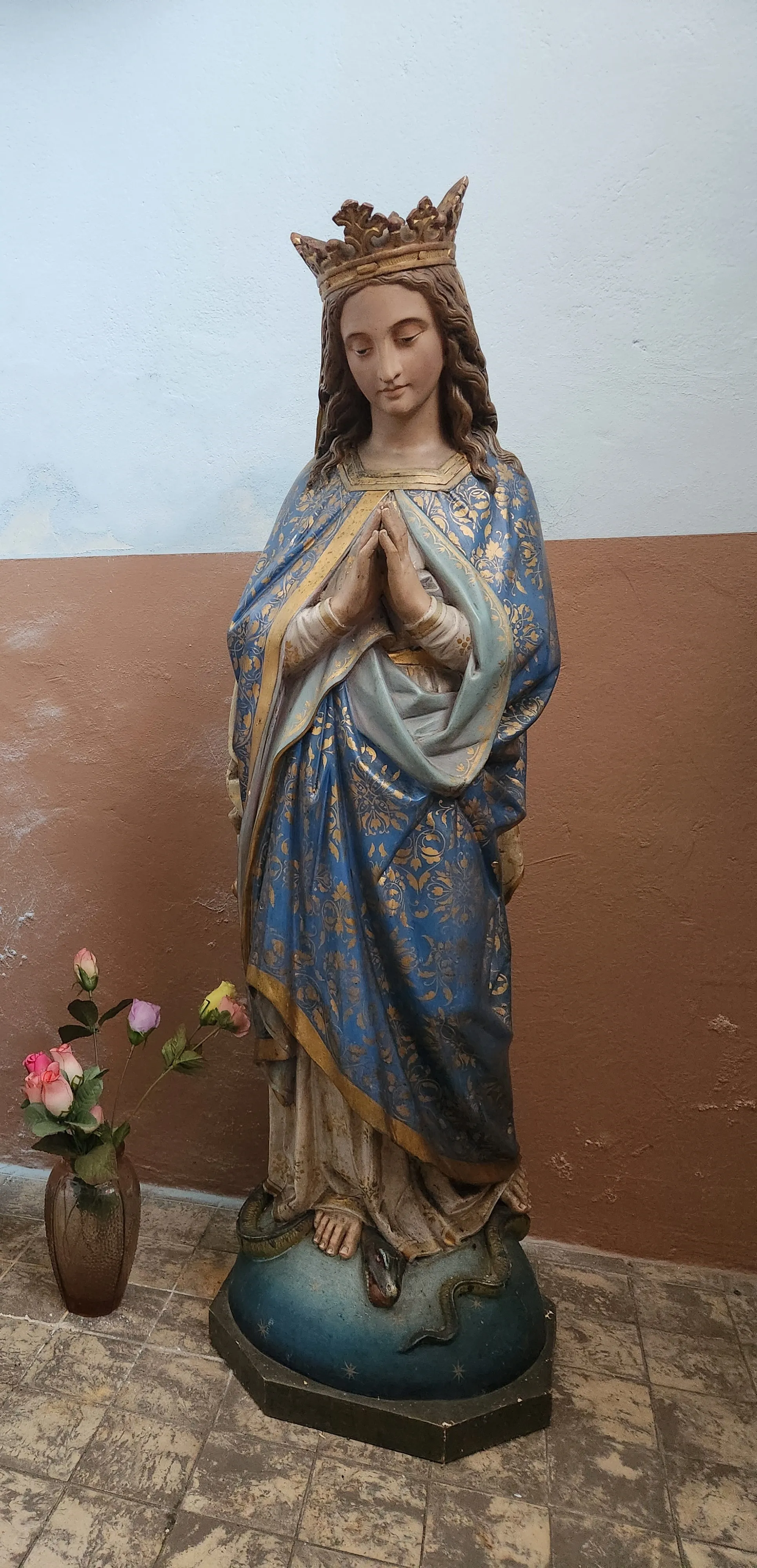
This statue shows Mary crushing a serpent beneath a terrestrial globe. It formerly stood on the side altar before being replaced by Saint Libaire and moved to the baptismal chapel.
Depicted with the infant Jesus, Saint Joseph completes the protective figures of the church. He symbolises fatherhood and the protection of the Holy Family.
The fourteen stations of the Way of the Cross are arranged along the nave walls. Each panel illustrates a stage of the Passion of Christ, from his condemnation to his burial.
The baptismal chapel, painted sky blue, is accessible from the nave through an archway and closed by leaves from the wrought iron chancel screen (18th c.). It contains:
The former baptismal font (set into the chapel wall) was moved during the 1961 works and now stands in the garden of the adjacent presbytery.
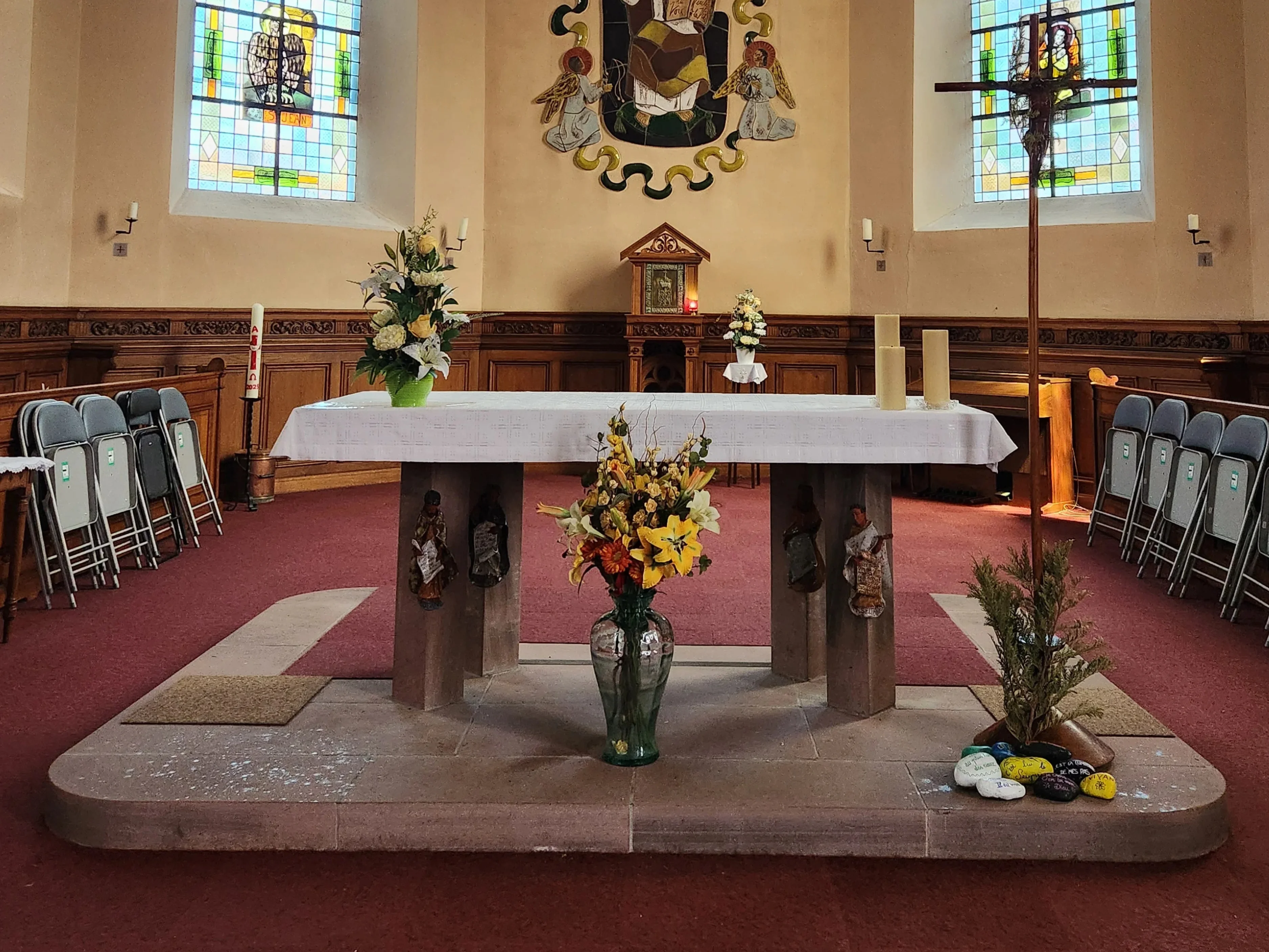
The new main altar in Champenay sandstone was created in 1961 during the major restoration. Supplied by SA Wenger, Petit et Cie (Schirmeck), it originally had 8 legs (only 4 remain today).
The altar is arranged versus populum (facing the people) in keeping with the liturgical recommendations that would be officially adopted by Vatican II (1962–1965).
Relics were inserted into the altar at its consecration: those of the Roman martyr saints Adeodatus and Celsus, along with those of Saint Libaire.
Champenay sandstone (from the commune of Plaine) was used for the main altar, the baptistery, the chancel steps and the consecration crosses. It is an entirely local material, used for the portal as early as the 18th century.
"Jesus said unto him, Thou shalt love the Lord thy God with all thy heart, and with all thy soul, and with all thy mind. This is the first and great commandment. And the second is like unto it, Thou shalt love thy neighbour as thyself. On these two commandments hang all the law and the prophets."Matthew 22:37–40
The sacristy houses several pieces of religious goldsmithery recorded in the General Inventory of Cultural Heritage (file IM67015405): a monstrance, two reliquaries and a relic of the True Cross. These objects bear witness to the devotional richness of the parish over the centuries.
The monstrance, the centrepiece of liturgical goldsmithery, is used during the exposition of the Blessed Sacrament and processions. The one at Sainte-Libaire features a radiant sun in silvered and gilded metal, with a central lunette to hold the consecrated host. Its ornate base is characteristic of 19th-century craftsmanship.
The monstrance is displayed on the altar during Eucharistic adoration and carried in procession on the Feast of Corpus Christi. It is one of the most emblematic sacred vessels in Catholic goldsmithery.
A second reliquary is also preserved in the sacristy.
This architectural reliquary houses relics of Saint Libaire, patron of the church. It features neo-Gothic decoration in gilded metal with pinnacles and ogee arches. At the time of the altar's consecration in 1961, a portion of the saint's relics was also sealed within the altar table.
This reliquary preserves a purported fragment of the True Cross (the cross of Christ). The relic is set in a finely worked gilded metal mount, presented on an ornate base.
Relics of the True Cross have been among the most venerated in Christendom since the time of Saint Helena (4th century).
Two tombstones testify to the age of the church as a place of burial and form an integral part of the building's historical furnishings.
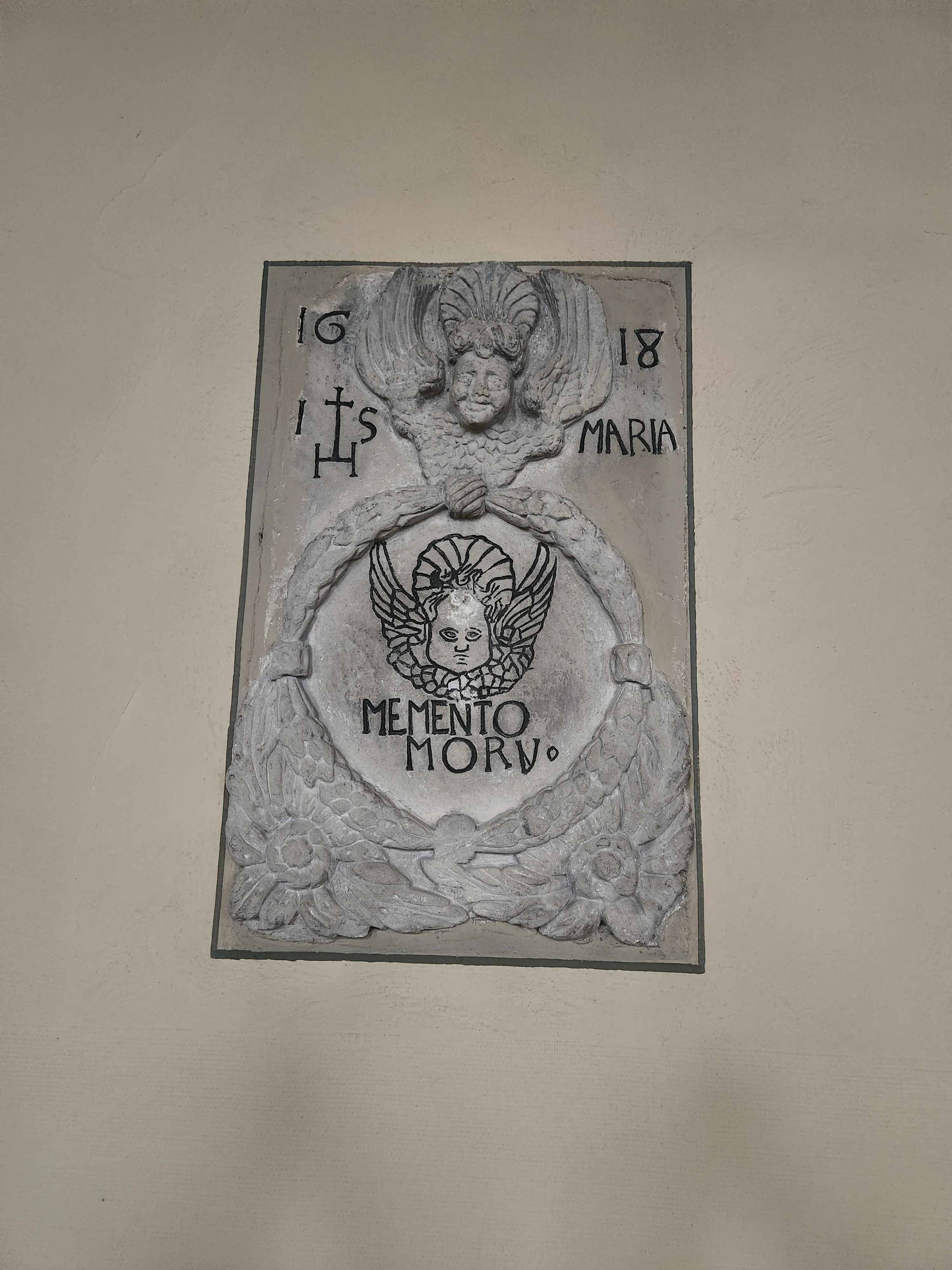
Decorated with the symbols IHS (Christogram), MARIA and MEMENTO MORI ("remember that you will die"), it is set into the church wall facing the pulpit. It testifies to the existence of a church on this site well before the reconstruction of 1736.
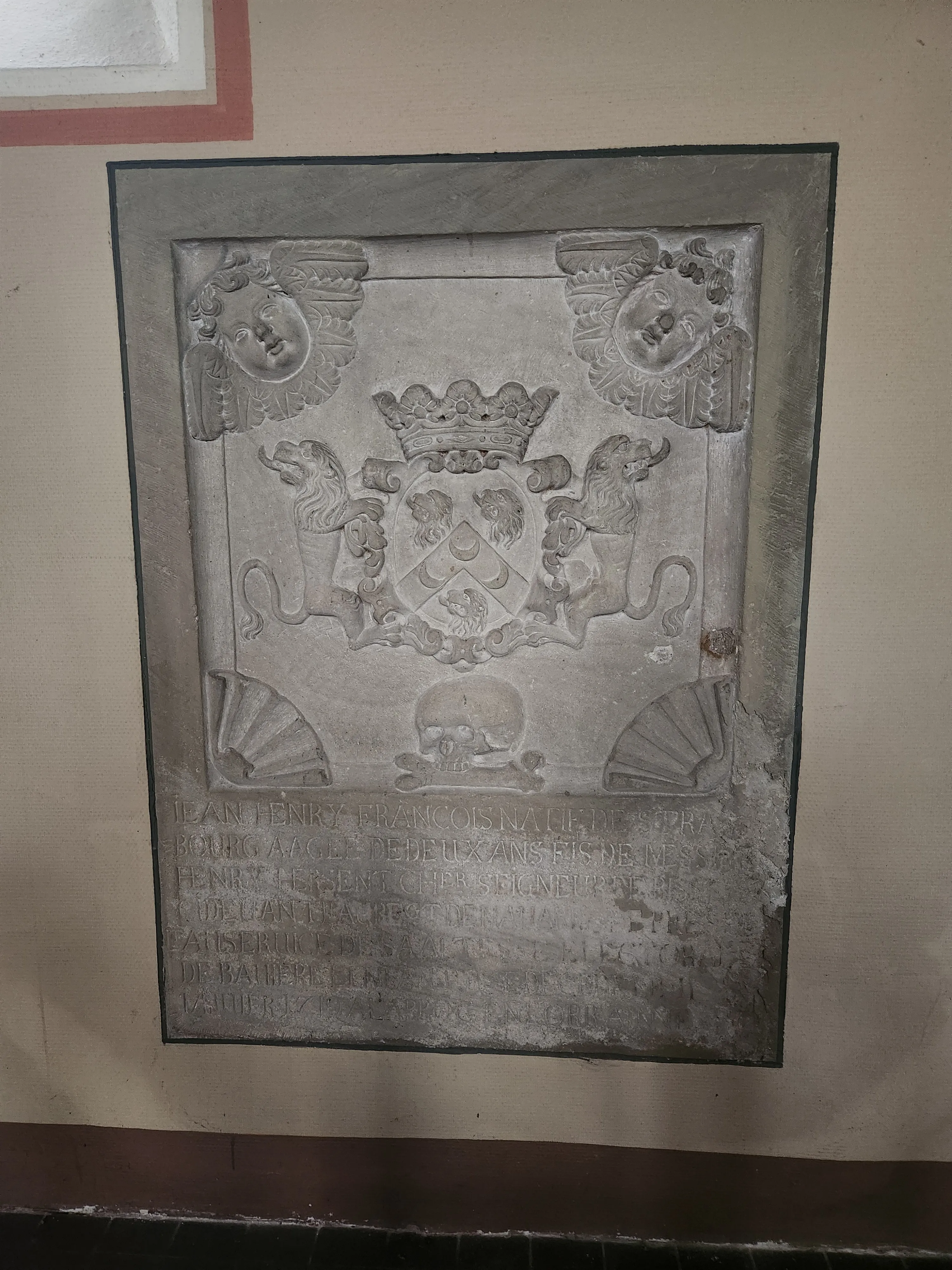
Placed beneath the pulpit, it is dedicated to Jean Henry François, son of Henri Hersent, only 2 years old, who died on 11 January 1719 at La Broque "en Lorrainne".